
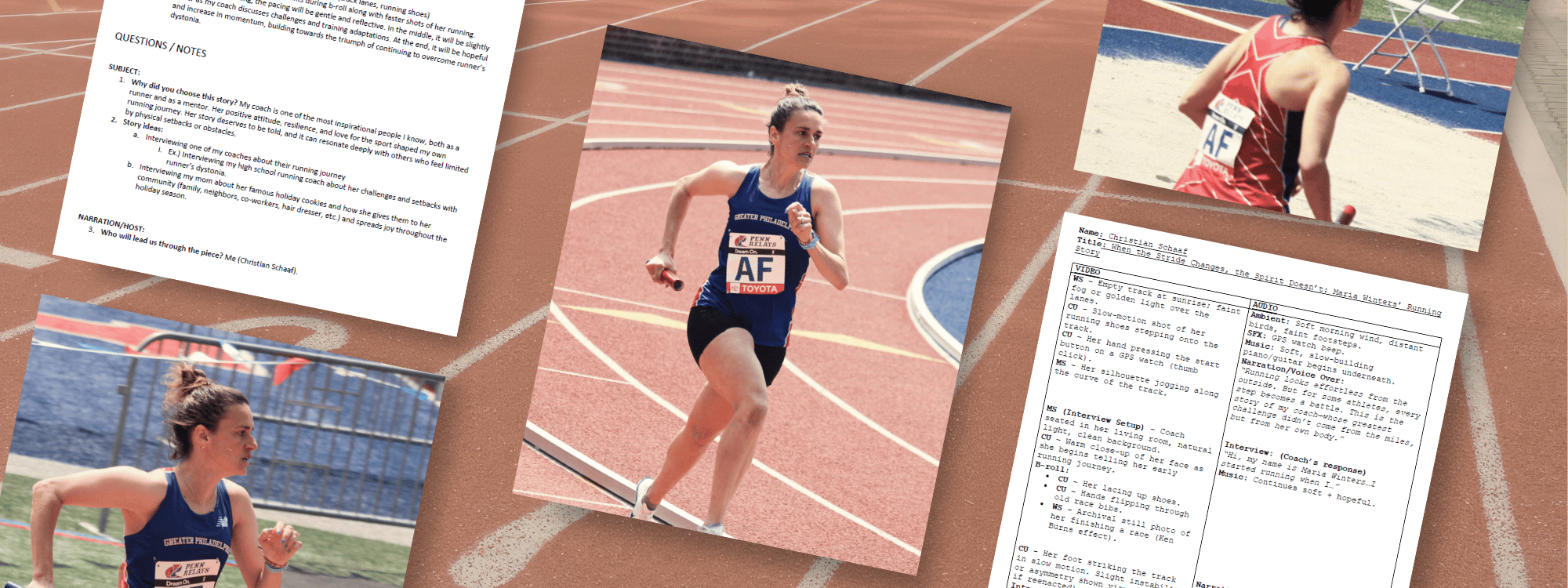
Mini-Documentary: A Story of Triumph
Brief
Every great story deserves to be told. When thinking about whose story to tell for this mini-documentary project, my high school cross country and track and field coach, Maria Winters, immediately came to mind. Maria has faced injuries and setbacks throughout her running career, but has always found a way to persist. At the center of her story is Runner's Dystonia, a rare neuromuscular condition that causes a disconnect between the brain and legs, making it difficult for the body to know how to hit the ground when running, leaving many unable to run at all. Not Maria. I felt a deep personal connection to this story; Maria had a profound impact on my own running career, and telling her story of triumph made this project that much more special.
Process
This project was mine to own from start to finish, spanning pre-production, production, and post-production. After reaching out to Maria and getting her permission to be filmed, I dove into research. I watched Nike's Breaking 2 trailer and Tracksmith's Chasing 2:37 video to study how elite brands tell athletes' stories and what kinds of shots they use. These videos gave me a strong foundation for how I wanted to structure my own.
From there, I completed a detailed pre-production planning document outlining every key element of the video: length, deadline, objective, elevator pitch, interview questions, b-roll ideas, music, and permissions. I also wrote out an example script mapping not just the audio, but the visual variety of shots I planned to capture.
During the production phase, I met Maria at her home and at a local track. I set up three-point lighting in her home to ensure even, quality lighting for the interview, filming with a Canon DSLR camera and tripod. I asked all of my prepared questions and gave Maria the space to speak freely about her journey with Runner’s Dystonia. At the track, I captured a wide variety of b-roll footage, from close-ups of her tying her shoes to wide establishing shots of her running. I also recorded my narration voiceover in Adobe Audition to fill in the gaps of her story.
In post-production, I edited the video in Adobe Premiere Pro and used Adobe After Effects to add animations. To bring the feeling of triumph to life, I created a filter that gave the footage a warm sunrise effect. I carefully selected a background music track that slowly built throughout the video, rising alongside Maria's story as she describes how she overcame her condition. The final product was a four-minute mini-documentary, now live on YouTube, weaving together her interview footage, b-roll, and narration into one cohesive story.
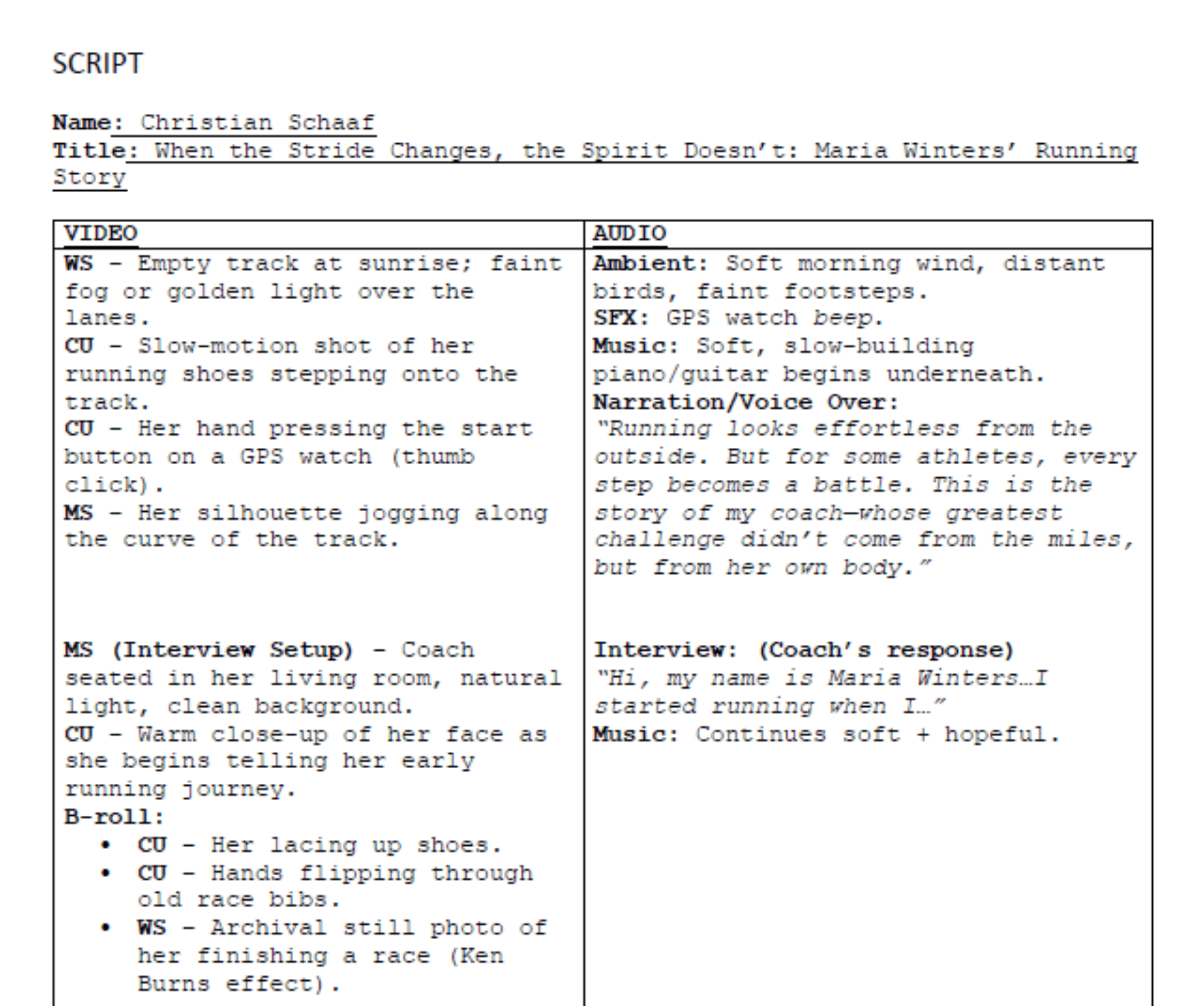
Mini-Documentary: Maria’s Running Story
Outcome and Takeaways
The result was a three-minute mini-documentary that captures Maria's remarkable story of perseverance and triumph over Runner's Dystonia. The video brings together interview footage, b-roll, narration, music, and visual effects into a cohesive and inspiring film that honors her journey and the impact she has had on so many around her.
This project was one of the most meaningful I have taken on. Managing every phase, from pre-production planning to filming to editing, taught me how to communicate clearly with a subject, think critically about visual storytelling, and bring a concept to life from the ground up. It deepened my skills in Adobe Audition, Premiere Pro, and After Effects, and reminded me that at the center of every great video is a great story worth telling.